Endodontics
Root resorption
A process where the body slowly breaks down part of a tooth's structure.
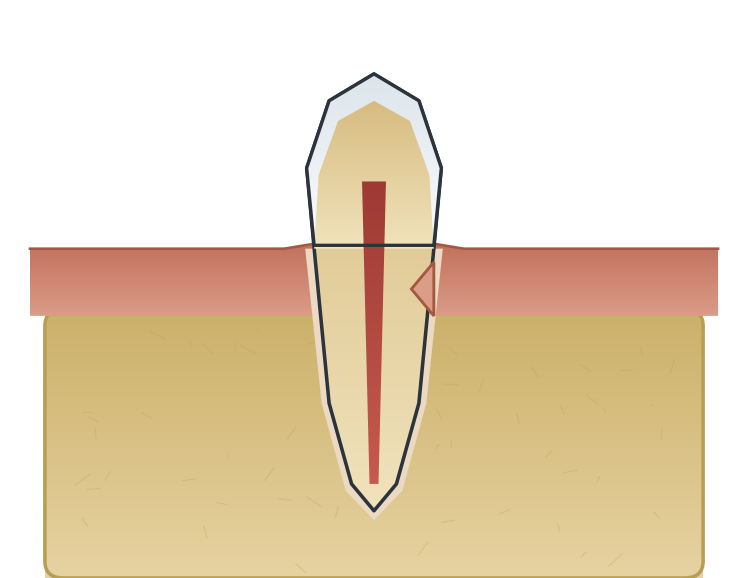
What
Tooth breaks down
Symptoms
Often none early
Found by
X-ray
Outlook
Depends on extent
Overview
Root resorption happens when cells that normally remodel bone begin to dissolve part of a tooth. It can affect the root or the crown and often causes no symptoms early on.
It may follow injury, pressure from orthodontic movement, or other causes that are not always clear. It is often found on an X-ray, and treatment depends on how much of the tooth is affected.
What to know
- The body slowly breaks down part of a tooth
- Often has no early symptoms
- Usually found on a dental X-ray
- Treatment depends on how advanced it is
Common questions
What causes root resorption?
It can follow injury, orthodontic pressure or grinding, though sometimes no cause is found.
How is it detected?
Often by chance on an X-ray, as it can be painless until advanced.
Can it be treated?
Early cases may be managed; advanced ones can be hard to stop and may need removal.
Is it the same as decay?
No, decay is caused by bacteria, while resorption comes from the body's own cells.
Will I lose the tooth?
Not always; the outlook depends on how much tooth has been affected and where.
Related topics
Root canal treatment
Treatment that saves a tooth by removing infected or damaged tissue inside it.
Cracked tooth & the nerve
How a cracked tooth can irritate the nerve and what can be done about it.

Dental X-rays
Images that show problems between and inside teeth we cannot see.
Loose tooth
An adult tooth that moves more than it should.
Dr Rick Iskandar · Reviewed June 2026